
Green transition and sustainable finance
Providing finance for the green transition is the most effective contribution a bank can make to a sustainable future. OTP Group embeds measurable green lending and financed emissions reduction targets into its strategy to support a fair, gradual transition to a low-carbon economy. By expanding its green loan portfolio and introducing a climate target-setting framework, the Group actively manages climate risks and supports clients in adapting to a sustainable economy.
Our climate target

OTP Group is committed to sustainability across multiple dimensions, with key priorities including green lending, the decarbonisation of our own operations, and reducing the carbon footprint of our financed portfolio.
For more information, please refer to the document below.
Sustainability efforts of OTP GroupSustainable finance
Environmental considerations are becoming an increasingly important factor in economic and investment decisions, supporting the achievement of sustainable growth.
OTP Group has established its green lending criteria and
definitions in line with international best practices and in full compliance with supervisory expectations.
The green criteria apply across the entire OTP Group. Green corporate or retail exposures include on-balance sheet loans, advances, leases, and bond exposures that have undergone an internal green alignment assessment process.
Following this assessment, and based on the client’s and/or business line’s intention, the exposure must meet the requirements of at least one of the frameworks or criteria listed below:
For non-financial companies and municipalities
- OTP Sustainable Finance Framework (SFF)
- The Hungarian National Bank's Green Corporate and Municipal Preferential Capital Requirement Programme
For the retail segment
- Hungarian National Bank’s Green Housing Preferential Capital Relief Programme
- Funding for Growth Scheme – Green Home Programme
- OTP Mortgage Bank Green Mortgage Bond Framework
- EU Taxonomy substantial contribution criteria for real estate and zero-emission vehicles
In addition to the above, green exposures may also be recognized based on external verification.
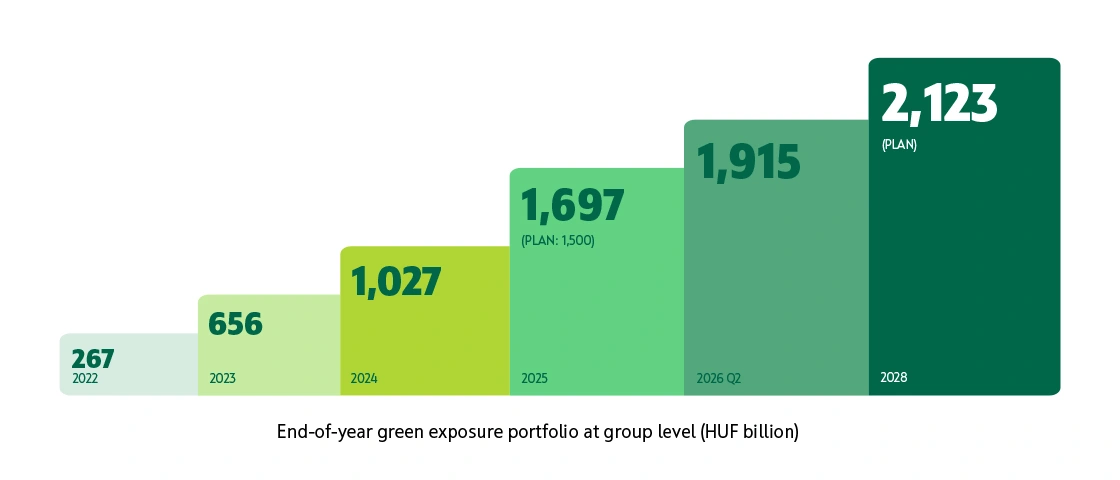
In the Sustainability Strategy for the 2026-2028 period, OTP Group has set a new target of achieving a green portfolio of HUF 2,123 billion.
Sustainable Finance Framework
OTP Group’s Sustainable Finance Framework provides the foundation for its sustainable funding activities, covering both environmental and social domains. Aligned with leading international standards, the framework enables the consistent classification and management of sustainable financial exposures across the Group.
Updated in 2024 and externally validated through a Second-Party Opinion (SPO), the framework supports the issuance of green and social instruments aligned with ICMA and LMA principles, while explicitly excluding high-risk sectors. It focuses on key environmental and social impact areas and ensures transparent allocation and impact reporting.
Explore OTP Green Bonds

Find more information on OTP Green Bonds and other international debt securities issued by OTP Bank
Read moreEnvironmental and Social Risk Management Framework
The Environmental and Social Risk Management Framework (ESMS) is a structured system that guides how the Group identifies, evaluates, and manages environmental and social risks linked to its financing activities. It establishes clear processes and responsibilities to ensure these risks are mitigated and aligned with sustainable and responsible banking practices.
Environmental and Social Risk Management Framework of OTP Group
Environmental & social concerns

We offer opportunity to be heard and assisted through a grievance mechanism. Read more
Contact usGreen transition
In 2025, OTP Group strengthened its approach to supporting climate‑change mitigation through its lending activities, integrating key elements of the European Sustainability Reporting Standards (ESRS).
Due to the nature of banking, financed emissions—representing the majority of total emissions—depend on clients’ activities and currently rely on evolving data methodologies. As a result, a fully ESRS‑compliant transition plan for financed emissions will be developed as data quality and availability improve.
Despite these limitations, OTP Group is actively reducing its own emissions and setting interim targets for the GHG intensity of its credit portfolio, aligning with CSRD requirements and supporting the transition to a low‑carbon economy.
Our investment and banking services both have sustainable investment and financing solutions
OTP Group offers a wide range of sustainable investment and financing solutions, with a growing emphasis on environmentally responsible products across its portfolio.
On the investment side, OTP Group through its fund and asset management company, OTP Fund Management Ltd. provides dedicated responsible investment opportunities, including:
- OTP Climate Change Total Return Derivative Fund
- OTP Omega Developed Market Equity Fund of Funds
- OTP Ökotrend Alap (only in Hungarian)
In addition, OTP Group has played a pioneering role in sustainable capital markets, being the first institution in Hungary to issue green mortgage bonds, thereby supporting the development of green financing instruments.
Alongside its investment products, OTP Group actively supports sustainable projects through targeted lending programmes. These include:
- interest-free loans provided to condominiums and housing cooperatives for energy efficiency improvements and renewable energy investments,
- dedicated green housing products such as Croatia’s Sunny Loan, supporting energy-efficient home construction, purchase and renovation,
- and cooperation frameworks with international financial institutions, particularly the EBRD and the EU.
Sustainable Finance Framework - Previous Reports
Responsible Banking and Financial Well-Being
OTP Group aims to service all customer segments. All our products and services are designed to comply with the principles of ethical business conduct and legal requirements.
Responsible lending
Crediting helps economic and individual development and the achievement of goals, but at the same time, imprudent credit can cause serious long-term problems for debtors through over-indebtedness and can also put the providers of the funds at risk.
We ensure that retail customers are not over-indebted by means of a solvency test. We also inform customers of the results of the Central Credit Information System (CCIS) query and also if their application is rejected at credit assessment on account of over-indebtedness. The training of administrators, internal Administrative Directives and the automation of the credit approval system ensure compliance with the relevant procedures. We also examine over-indebtedness in the context of corporate lending.
We make sure that our employees have up-to-date knowledge of risk management principles and practices on an ongoing basis.
Financial well-being and social impact products
OTP Group aims to ensure financial well-being for its customers and to have a positive impact on society through its many products.
- Our discounted products are primarily aimed at young people, customers looking to purchase or modernise their homes or to improve their energy efficiency, and pensioners.
- We place particular emphasis on serving the financial needs of residential communities and municipalities (where local regulations allow).
- Many of our services are aimed at meeting the needs of small and medium-sized enterprises.
Risk management
The identification, assesment andmanagement of risksis a fundamental element iof OTP Group’s operations. The Risk Management Strategy provides uniform framework for risk management across OTP Group. Within therisk appetite framework, the Group continously compares the level of risks undertaken with expected losses and the costs of risk management in order to determine an optimal, sustainable level of risk-taking.
Risk management principles and practices are aligned with the criteria of responsible lending. OTP Group grants loans from customer deposits with the expectation of full repayment, ensuring that financing activities do not support illegal purposes or activities that are inconsistent with societal values and responsible business conduct.
The effectiveness and balance of risk management are supported by:
- a prudent and consistently applied Risk Management Strategy
- an annually reviewed Lending Policy
- and continuously enhanced credit risk assessment system
In corporate financing, OTP Group applies an ESG exclusion list that identifies activities and behaviors incompatible with the Group’s values, particularly in relation to the protection of human rights and the promotion of sustainable development.
The Group places strong emphasis on the identification and management of ESG risks. The ESG risk management framework embedded in loan origination and monitoring processes aims to support sound decision-making through the systematic identification and assessment of environmental and social risks. ESG considerations are also integrated into operational risk management processes. In addition, the Group performs climate stress testing to assess the potential impacts of different climate scenarios on its risk profile.
In line with the Risk Management Strategy, Group members continuously review and improve their risk management practices. Lending policies clearly define the sectors, business activities and exposures in which the Group is willing to assume risk, as well as those areas where it deliberately avoids risk-taking.
ESG risk management across the value chain
Managing and minimizing ESG risks is an integral part of OTP Group’s operations, extending across the entire value chain. The Group integrates ESG considerations into both its internal processes and external business activities, particularly in financing and lending decisions, ensuring that environmental, social, and governance risks and opportunities are systematically assessed.
The Group’s approach focuses on embedding ESG criteria into decision-making processes to reduce adverse environmental and social impacts while supporting sustainable economic development. This includes the evaluation of client activities, the application of responsible financing frameworks, and the promotion of more sustainable practices among partners and stakeholders.